 English
 Italian

The processing of Murano glass can be carried out following various techniques, each of which gives different effects. Among the best known, in addition to the murrina and avventurina we have already talked about, we find:
- BLOWING: is the technique mainly used for glass processing. It dates back to the first century B.C., and is based on the use of the blow pipe inside which the master blows air making it reach the mass of incandescent glass, taken from the furnace, at the other end. This mass is worked to obtain the desired shape, rolling it several times on a sheet of iron (marbling) and using special tools.
- THE PHILIGRAN: decorative technique conceived by master glassmakers between the end of the 15th and the first half of the 16th century to decorate crystal blown pieces (transparent glass). The technique involves the use of crystal rods (rods) inside which there are white or coloured opal glass threads, which are aligned on a metal plate and placed in the furnace so that they heat up and adhere to each other, and then rolled onto a cylindrical object to which they adhere.
- RETICELLO : Variant of the watermark, made with the same procedure, but characterized by the crossed arrangement of the rods used for decoration. At the intersections of the rods a small air bubble remains imprisoned and appears in the centre of the filigree threads, giving it a sense of lightness.
- RITORTOLI FILIGRANE: another variant of the filigree, in which the rods contain twisted or spiral wound threads and are included in a transparent glass. This decorative effect is also called zanfirico.
- CALCEDONIO: variegated opaque glass, with polychrome veins, in imitation of semi-precious stones such as zoned agate, natural chalcedony, onyx, malachite, etc.. It is obtained by mixing fragments of white opal, colored opal glass and crystal. When the fusion is completed, a mixture of colouring compounds, such as silver nitrate, cobalt oxide, potassium dichromate, etc., is added several times, which are dispersed by mixing the melt.
- INCALMO: a technique that dates back to the 16th-17th centuries, consisting of hot welding pieces of glass of different colours to obtain the desired shape by shaping them together. This technique requires great skill on the part of the master. - OPACIZZAZIONE operation to make the glass opaque by treating the object with hydrofluoric acid.
- SOMMERSO: is composed of an outer layer of glass superimposed on a layer of different colours, and is obtained by dipping the glass in crucibles of different colours. The object is thus composed of different layers of different thickness and colours, with incredible chromatic effects.
- “INCAMICIATO” GLASS: a technique similar to submerged glass but usually thinner, consisting of 2 layers of overlapping glass.
- GOLD OR SILVER LEAF: 24k pure gold foil, which is collected from the glass in a pasty state at the beginning of processing. The gold can be covered with another layer of transparent glass. If the glass is blown, the gold leaf shatters into a golden dust. Since the 19th century, silver leaf has also been used, which must be coated with another layer of glass to prevent oxidation and unsightly browning.
- LIGHT WORK: is performed using a colored glass rod softened with fire by a blowtorch, and allows you to make objects in any shape you want.
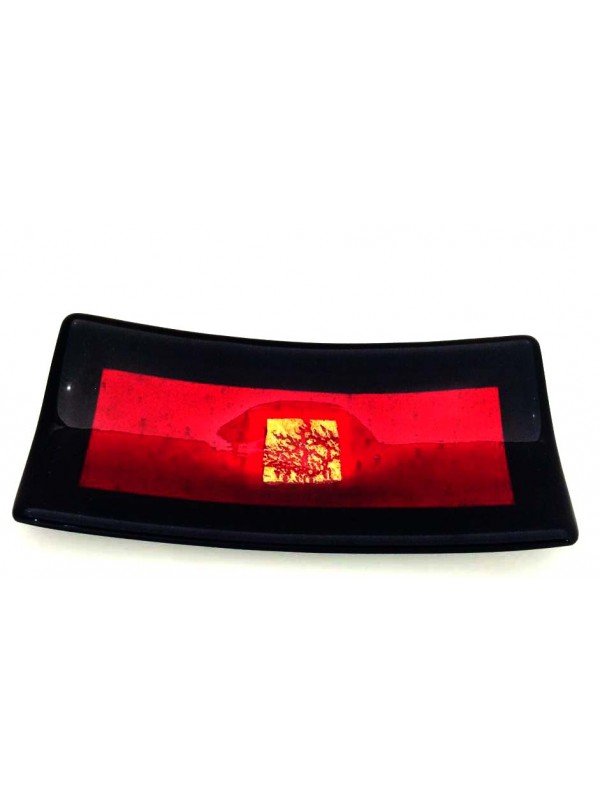
- VETROFUSION: a very ancient technique, already used by the Egyptians and the Romans, which was rediscovered by craftsmen in the 1970s. It is a technique that requires great skill, experimentation and knowledge of the physical characteristics of glass at high temperatures. The procedure consists in cutting and composing together different pieces of glass, which are then melted in the furnace to be welded.
- MOLATURE tecniche that allows to dig the glass, which is carried out in different stages using different types of wheels.
-BATTITURA: technique dating back to the 1930s. Beaten glass is characterised by an unevenly ground surface. The master, with an appropriate wheel of roughness, nicks the surface of the object with thick and regular engravings,so as to remove the brilliance from the polished glass and create opaque areas.
